
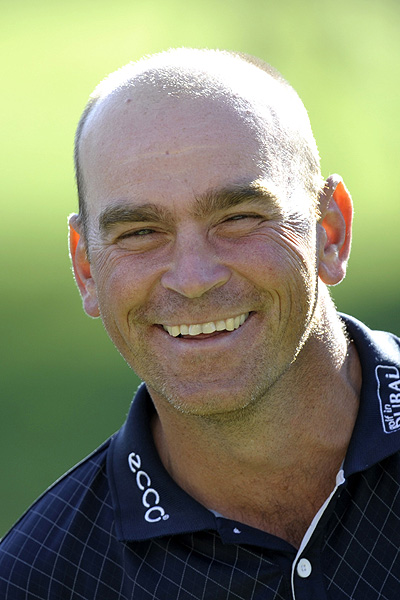
 It has often been said that any professional who takes on the chairmanship of the European Tour’s Tournament Players’ Committee will find that his game suffers. Thomas Born, who was given the role in 2007, could see it happening to him a couple of years ago and let it be known that he was thinking of demitting office.
When it came to the bit, however, he did not quit – and there are many who suspect that the extra responsibilities he has since had to bear have helped rather than hindered. In fact, there was one wag who suggested that Bjorn’s extraordinary success this season – he has won three titles at the time of writing – will have had others angling for his post.
When the 40-year-old Dane had his back-to-back wins across the end of August and the beginning of September, his low round of the fortnight came in the second week when he had a closing 62 to wrap things up at the Omega European Masters in the Swiss Alps. At a time when the leader board was bewilderingly cluttered at the top, he soared clear of his rivals, which included both Lee Westwood and Rory McIlroy, with a run in which he was as many as five under par for his last five holes.
However, it was the Sunday of the preceding Johnnie Walker Classic at Gleneagles which tells more about the man Bjorn has become. That was when he came out on top of what was a five-hole, five-way play-off against four younger rivals – Bernd Wiesberger, Pablo Larrazabal, Martin Foster and George Coetzee. The stage for that “sudden-death” play-off which, paradoxically, took an hour and three-quarters, was the 18th, an uphill par-five. On that gloomy Perthshire evening, it was playing every inch of its 533 yards.
At the start, Bjorn was relaxed about the situation, merely counting himself lucky that he was still in contention for the title. Foster, after all, had been three ahead with seven to play before running up a bogey via the trees at the 72nd. Again, there was an element of safety in numbers as the quintet teed up for a first time. “It was when it got down to two of us,” said Bjorn, “that it became really nerve-wracking. That was when you started to think, ‘I’ve done all the hard work … I really don’t want to lose at this stage.’”
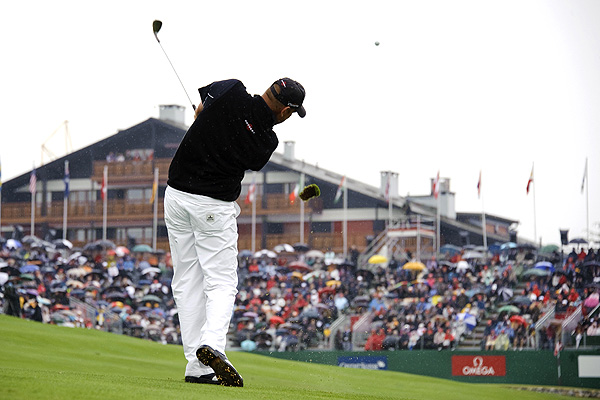 There was not a soul at Gleneagles who was not wrapped up in the mounting pressure.
Bjorn, as he dug deeper and deeper, seemed to age with each passing hole. After a couple of pars had been enough to carry him through the first two lengths of the 18th, he moved into birdie mode.
The first two of those two birdies were matched and it was the third of them, where he hit a seven-iron through the dying light to two feet, which won him the tournament as Coetzee, the last challenger, caught some cloying rough by the green. The moment Bjorn had done what he had to do, he was back to being 40 – and a young 40 at that.
“You just have to keep going,” he said of the tension that had taken hold. “It was getting tougher and tougher and, if it had gone on much longer, it might almost have reached the point where you struggled to take the club back. But I kept at it – and I don’t mind saying I’m proud of the way I played my last three holes.”
It was Todd Hamilton, the former Open champion, who gave a very good insight as to how Bjorn had been able to outshine his up-and-coming adversaries over that extraordinary six-hour afternoon.
“When you get to 40,” said the now 46-year-old Hamilton at Crans Montana the following week. “You’ve known every situation the game can throw at you. Nothing can surprise you as it might a younger player.”
Bjorn, for his part, talked of how there had come a moment earlier in the year when he had been struck by the realisation that he would not be on tour forever. “You want to make the most of the years you have left,” he said. 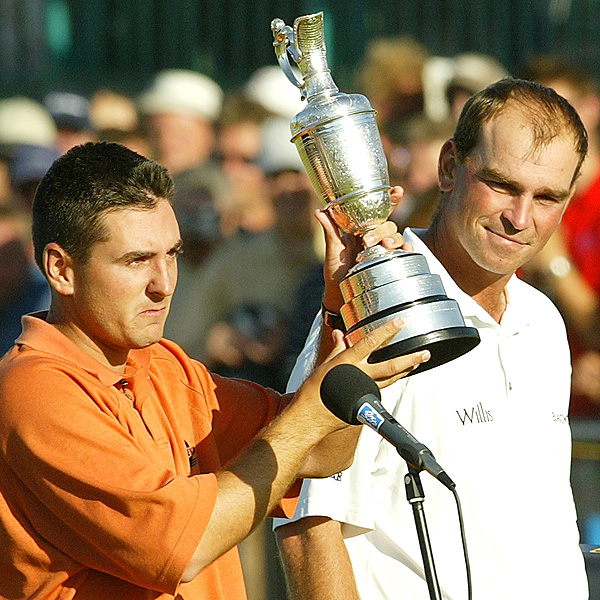
Citing players like Miguel Angel Jimenez and Darren Clarke – two more in their 40s who are playing as well as they have ever done – he said, “You’ve just got to keep believing and, as long as you stay healthy, that’s the most important thing. I’ve had injuries and will go on getting them so I have to work harder than ever to keep my fitness intact.”
Yet for many, the way in which Bjorn, who has leapt to No 27 in the world rankings, interacted with his playing companions over the play-off in Scotland was even more impressive than the guts and the golf.
Across the years, this two-time Ryder Cupper has gone through as much pain on a golf course as anyone, most notably at Royal St George’s when he took three to escape the right-hand bunker at the 16th to gift the 2003 Open to Ben Curtis. Even as tactful a man as Peter Dawson, the chief executive of the R&A, referred to that hazard as “Bjorn’s Bunker” at the start of this summer.
In 2004, Bjorn was still suffering and, when he walked off the course during that year’s European Open, he admitted to being “assailed by demons.” Jos Vanstiphout, from the ranks of the golf psychologists, helped him to sort himself out mentally and when he returned to the winner’s circle at the British Masters just a year later, he talked through what he had learned from those dark times.
Essentially, he had come to see that he had become too hard and too focused on himself. “You’ve got to be happy for others when they are successful,” he ventured. “The world doesn’t come to an end if I don’t win. Someone else wins and you have to be happy for them, because it’s good for the tour and the tour is bigger than the players.”
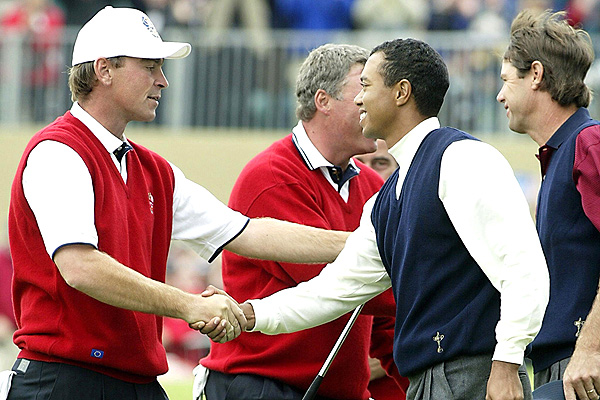 That same philosophy has played no small part in his chairmanship of the TPC.
He keeps an eye out for his fellow professionals. Oliver Fisher, when he won in Czechoslovakia, noted that Bjorn had loomed large among those senior players who had consistently offered words of encouragement as he missed 21 out of 22 cuts earlier in the season. Nick Dougherty was another to mention the Dane in a list of those who had supported him through the 22 missed cuts which prefixed his spectacular opening 63 at the European Masters.
At Gleneagles, Bjorn’s courtesy over the five extra holes was all to do with the quiet concern he showed for each of Wiesberger, Larrazabal and Foster as they dropped out of the running. And then for Coetzee as he beat him on the last lap.
Speaking the following week, Foster said that Bjorn’s words had meant everything on a night when he would otherwise have been at his wits’ end at the way he had lost a tournament he should so patently have won.
“Thomas knew what it was to be in the position I’d been in and he knew precisely what was going through my head,” said Foster. “He could not have been more gracious in what he said to me. He told me I’d been playing well all year and that I should just keep playing the way I’d been playing.
“When Thomas says something, he means it. What’s more, I know that he would have been just as gracious – in fact he would have been genuinely pleased for me – if I’d holed the putt I needed to win at the 72nd. That’s the kind of man he is.”
Coetzee, for his part, said that Bjorn had made a point of congratulating him on the great come-back – a final-round 67 – which had lifted him into the play-off.
Those five extra holes could have wider repercussions for Bjorn, particularly in terms of the Ryder Cup.
The people of Scotland were looking to identify the right captain for the 2014 event, which will be held at Gleneagles for the first time. Colin Montgomerie is still considered a possibility in that few can picture a scene in which this incorrigible soul, who lives round the corner from the famous resort, is not involved.
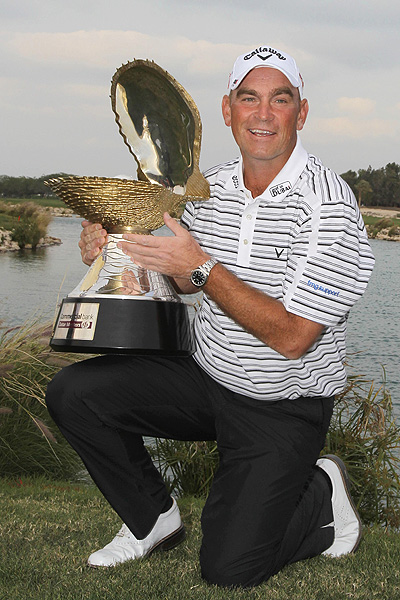 Clarke more or less ruled himself out when, in the wake of his Open win, he reiterated that Gleneagles’ PGA Centenary Course is not the right venue.
Which leaves us with Paul McGinley and Bjorn. McGinley has the requisite leadership qualities – he has skippered Great Britain & Ireland’s Seve Trophy side to two consecutive wins – but it would now come as little surprise if Bjorn’s is the name announced when the decision is made following the 2012 match at Medinah.
Indeed, a film of that Sunday night at Gleneagles could serve as Bjorn’s resume, capturing as it did a player handling an extreme situation in the optimum way. What is more, if those doing the choosing were to need any references, they could call upon the four beaten men.
“I don’t think Thomas would mind my saying this,” said Foster, “but he epitomises that saying about fine wine. He’s got better and better. We’re lucky to have someone like him on tour.”
Click here to see the published article.